
By John-Paul Bonadonna
War telegrams carried the power to change a family’s life in a single sentence.
One message could tell a mother her son was safe.
Another could bring the devastating news that he was never coming home.
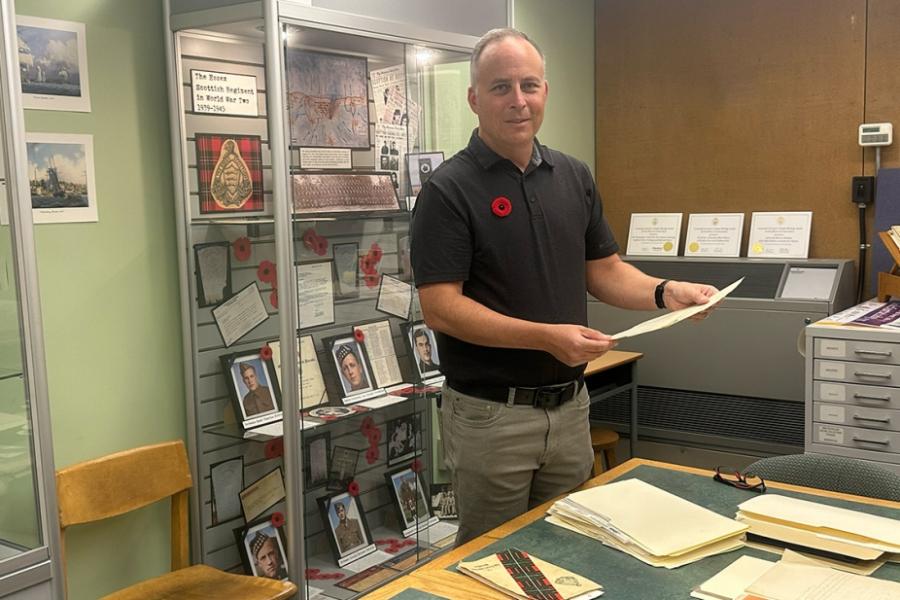
For David Yott, an archival assistant at the University of Windsor's Leddy Library, a telegram message sent by Private Joseph Cerullo to his parents – that is preserved in the archives – brought the human cost of the Second World War into sharp focus.
“It reads ‘All well and safe. Love and kisses. Please don’t worry.’ and then they later received another telegram delivering news of his death,” Yott says.
“Reading that really broke my heart. It was something my son would say to my wife right now.”
That personal connection is at the heart of a new display in Leddy Library's Archives and Special Collections reading room, where wartime records reveal the lives of local soldiers who never returned home.
Drawing on the Essex Scottish Regiment Archival Collection and the Students of Assumption College and University Collection, the display focuses on three former students who died during the Second World War as well as three others from the Windsor community who served in the Essex Scottish Regiment.
Private Jack Lovell, Private Remi Robinet and Lance Corporal Leo Trombley were listed as students of Assumption College
Private Joseph Cerullo, Sergeant Donald Dornan and Private Weldrick Walker were other members of the regiment from the Windsor community.
Through photographs, newspaper accounts, military records, school documents and personal correspondence, Yott has pieced together their stories, offering a glimpse into the lives behind the names.
The display also offers a sobering reminder of the war's devastating impact on Windsor-Essex.
Of the 553 Essex Scottish soldiers involved in the August 1942 raid on Dieppe, 121 were killed and 388 taken prisoner.
The failed Allied raid dealt a devastating blow to the regiment and the community it represented.
Assumption College, which at the time also included high school-aged students, lost more than 160 students and personnel during the Second World War. Their names are memorialized on the plaque that can be found in the lobby of the Memorial Hall building on campus.
Before the war, the six soldiers profiled had worked in bakeries, butcher shops and factories, including Chrysler.
“Young men who were on the brink of starting their lives,” Yott says.
Their stories emerge through the remarkable depth of the archival holdings.
The Essex Scottish collection includes regimental war diaries documenting the unit’s movements, battles and casualties along with photographs, prisoner-of-war camp records, maps, individual casualty cards and correspondence with soldiers’ families.
The display also features a German prisoner-of-war identification badge belonging to Sergeant Donald Dornan, an Essex Scottish soldier who was captured at Dieppe in 1942 and survived the war after spending time in various German POW camps.
Together, the records offer more than a military history. They reveal the personal experiences of soldiers and families whose lives were forever changed by the war.
That work extends well beyond this collection.
Leddy Library’s Archives and Special Collections preserves a diverse range of historical records, serving researchers, families, students and community members from Windsor-Essex and around the world. Yott estimates that the majority of visitors come from outside the University.
“It’s important to emphasize that our collections are accessible to the community,” Yott says.
“Most of the material used in this display came from our collections here at Leddy Library Archives and Special Collections.”
The new display offers visitors a chance to explore that history firsthand and discover the stories preserved within the University's archival collections.
Campus and community members can arrange an appointment to view the display, explore the collections or learn more about the archives by emailing libraryarchives@uwindsor.ca or calling 519-253-3000 ext. 3851.
For Yott, preserving these records is about more than safeguarding documents. It is about ensuring the people behind them – and the lives they led – are not forgotten.
Connect with your library